
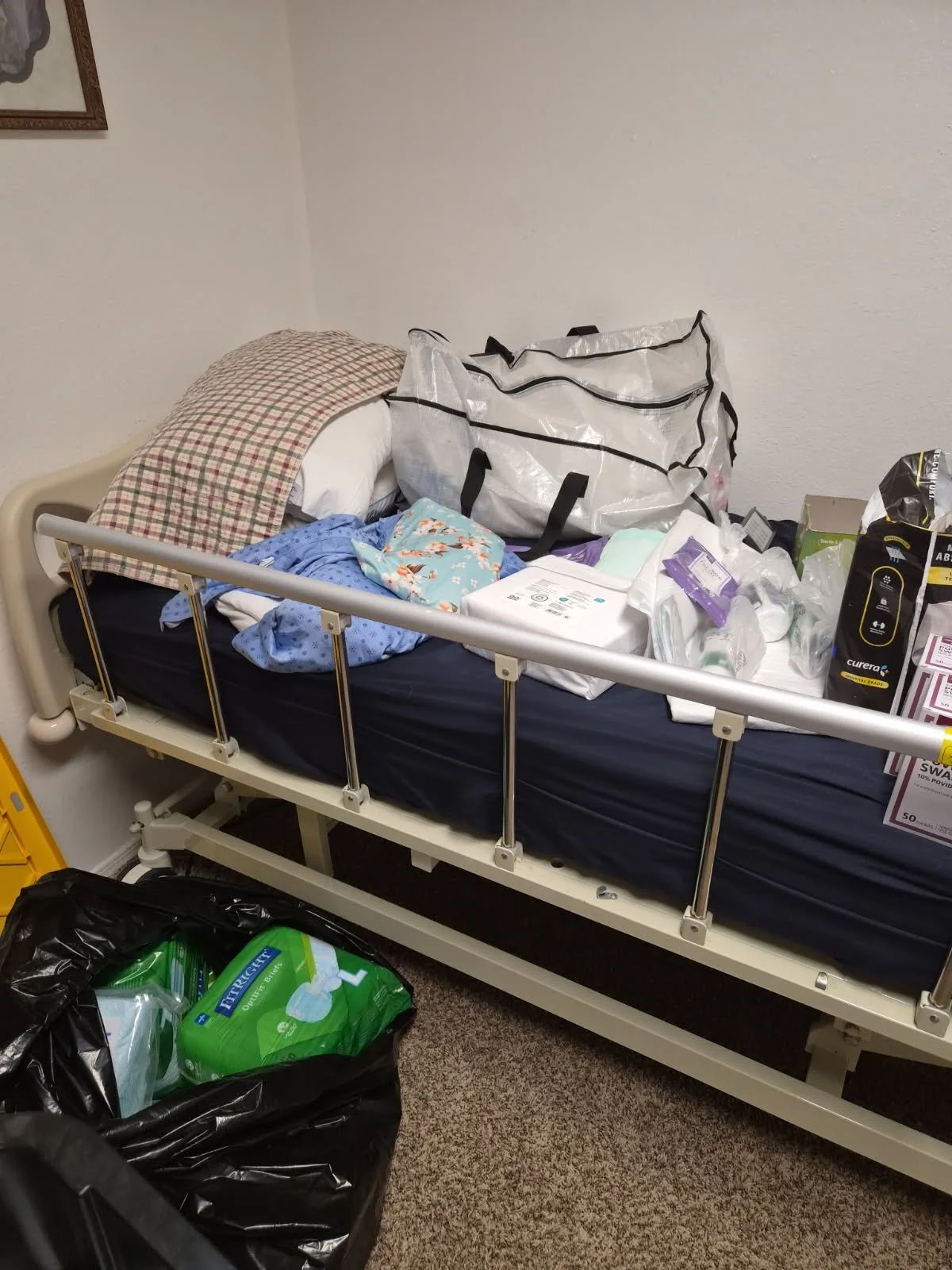
Medical bed full of stuff in a home after a loved one died.
In Part 1, I proposed that one of the most marginalized groups in the US are those who are dying. Today, I’m expounding on that a bit more.
Think about it.
Those nearing death may not have the strength to talk, to leave their home, to write a letter, to make a call. And at the very end, they are no longer even making decisions for themselves.
The old adage is true: that our end is very much like our beginning. We are completely dependent on others. But in the more modern case, those who are dying and their caregivers are also depending on a system.
And this current system is robbing people of their freedom.
They don’t have the resources and tools they need.
Family caregivers aren’t prepared and everything is demanded of them.
They can’t go where they want.
They get cornered by what’s covered by insurance and not or what they can afford.
Sometimes all of a person’s money is taken when they enter a “care” home or facility—or debt is accrued.
Many times, there is nothing else possible except to get through the day.
Humans deserve better than this.
Harold Braswell (author and professor at St. Louis University) is the first that I know of who proposed that those near death aren't free - and that the systems and politics take away their liberties.
And that their unpaid caregivers aren't free, since their lives are forcibly wrapped up in the caregiving and they don't even have time for some of the most basic things - because the system pressures them to do everything for their loved one, but also doesn't give them any help (or minimal).
But by the time that caregiving hits a family, it’s already too late to fight for freedom. At that point, it’s a fight to survive.
Advocacy needs to happen for the dying before they are dying.
And for the caregivers, even before they are caregivers.
Sadly, it's only after a death that we sometimes realize just how unfree our loved one was - and how unfree we were.
Let’s start to imagine how free that we will want to be when we are on our own deathbed, and create that world.
End of life care could be the most important systemic problem of our era.
Now is the time to re-imagine and re-create end of life care.
Inhora is doing exactly that.