
By Miles Gloetzner, Founder & Director of Inhora
I had the privilege of watching The Shawshank Redemption with my wife recently. Writer/director Frank Darabont brought Stephen King’s story to life impressively—I hope to read King’s book one day.
And, of course, I found death as a key theme to the movie so I had to write about it!
It all starts with a murder and the related trial. The jury finds Andy (Tim Robbins) guilty of killing his wife and he’s given a life sentence.
He becomes friends with another “lifer” named Red (Morgan Freeman). And the rest of Andy’s story is told through Red’s perspective.
I’ll jump into the first of two parts that stuck out to me.
Institutionalization
A fellow inmate, Brooks, who had been behind bars for 50 years is paroled. When he gets the news, he’s shocked—then tries to kill a peer for fear of leaving what had become his home. This leads to an interesting discussion among his peers about institutionalization. Red says this:
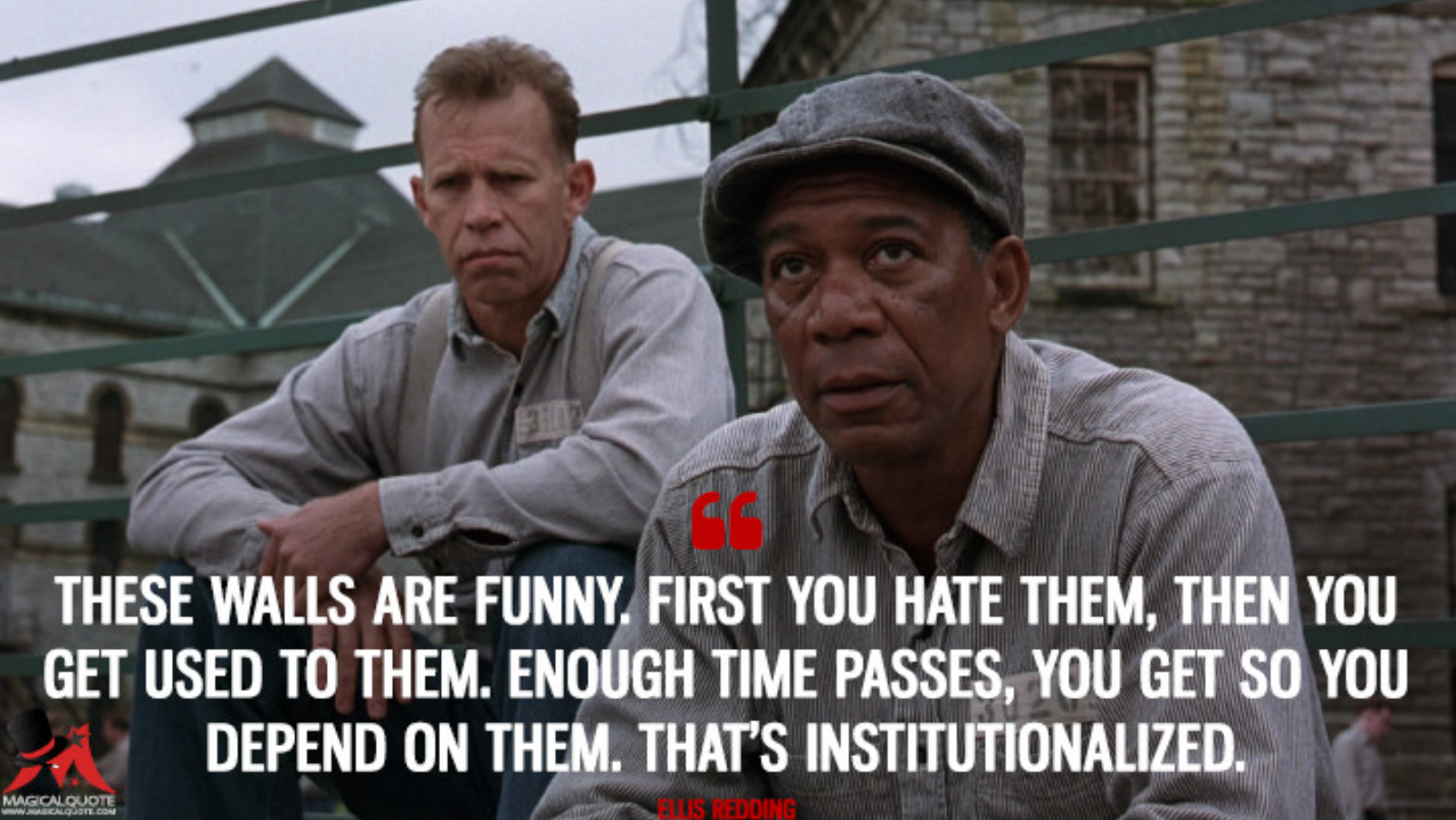
Picture of Red and a fellow prisoner sitting on a bench outside in a prison yard with overlaid words in bold white font, “These walls are funny. First you hate 'em, then you get used to 'em. Enough time passes, you get so you depend on them. That's institutionalized.”
This (and the rest of the conversation available here) is thought provoking.
I’m going to home in on how this relates to the medical system’s care of our elders. It’s sad to note that this “care” system does to elders what our justice system does to criminals. Here are some generalized comparisons that come to mind (there are two nuances*—see the bottom of the page):
When someone is deemed “no longer safe” to the general society, they are sent to prison; when someone is deemed “no longer safe” to be at home independently, they get sent to a nursing home.
Prisoners aren’t free to go where they want; residents of nursing homes aren’t free to go where they want.
Those behind bars have infrequent contact or calls from loved ones; same thing for our elders in institutions.
Prisoners see the same building & yard and eat the same ol’ food; same with the elderly.
People don’t like visiting jails; people don’t like visiting nursing homes.
Prisoners have limited extracurricular activities and don’t have control about what they are; same thing for residents of nursing homes.
There is limited access to religion and spirituality in prison; it’s rare for a priest, pastor, Rabbi, etc. to visit nursing homes.
Prisons are ugly and smelly; nursing homes are ugly and smelly.
When we institutionalize their wisdom, stories, and history then all society misses out. Even when families can’t visit their patriarchs and matriarchs, the community can step in. We need elders! And they need us.
Cherishing the humanity and dignity of our elders is a key inspiration for Inhora. It’s one way that we tell them that they matter and that we’ll be present for them until death. When community members give to our home, they are saying, “You’re important. You’re worth it. You are seen. You are loved.”
There are other ways that we can honor elders as every culture and religion has modeled for us. To humanize our elders in nursing homes, we can:
Plan a visit—bring something homey for their room
Speak with the activities director to offer a lecture, book club, concert, faith-based study, board games, etc.
Bring in flowers or table covers for the dining room
Learn how to “Be With,” “Advocate For,” or gather our elders’ stories through an organization like Compassionate Community Care.
Write a letter, call, or visit an elder—then make it regular
Importantly, honoring elders doesn’t include supporting them to get a legal prescription for a morphine overdose—MAID. Instead, we should accompany, befriend, get care resources, and build community around them.
*The above may be the norm, but not the rule. I’ve met wonderful leaders and employees of nursing homes, so I’ve got to temper this article with some nuances.
Nuance alert #1: Not all nursing homes are created equal - there are some which aim to create humane residences. Though these are usually costly, keeping them inaccessible to much of the population.
Nuance alert #2: These comparisons don’t apply to all nursing home employees. There are many warm-hearted nurses, clerks, janitors, and cooks in these spaces which do their best and become like family to the residents.